


New Mexico: A rare bright spot (for real this time) in the Land of Enchantment
Thu, 05/07/2026 - 10:05am
Once again: The true measure of ACA healthcare coverage enrollment isn't how many people select policies during the Open Enrollment Period, it's how many actually have those policies in effect (aka "effectuated enrollment") as well as how comprehensive the policy is (ie, its "Actuarial Value").
New Mexico is a massive positive outlier on both fronts in 2026, and it's pretty obvious how they're pulling it off: Not only is it the only state which is fully backfilling 100% of the enhanced federal tax credits which Congressional Republicans allowed to expire back in December for 100% of all enrollees, they doing this in addition to their existing state-based supplemental subsidy program.
In other words, while most states have seen their ACA financial assistance plummet and others are partially mitigating the damage, New Mexico is fully canceling out all of the lost subsidies as well as providing their own additional assistance this year. I don't know whether they'll be able to keep this going beyond 2026, but for the moment ACA enrollees in the Land of Enchantment aren't seeing any negative impact from Trump Regime policies or Congressional Republican inaction.
"But wait," you may be saying..."What about enrollees who earn more than 400% of the Federal Poverty Level (FPL), who are no longer eligible for any federal tax credits at all?
Fear not: New Mexico has them covered:
...A Senate committee Thursday morning agreed on a bipartisan vote to advance HB2, intended to protect about 6,300 New Mexicans from huge health care premium increases if federal tax credits expire as scheduled later this year.
...Accompanying the legislation the committee approved Thursday is a $17.3 million appropriation into the Health Care Affordability Fund, which the HCA oversees, to cover the premiums for policyholders whose income is 400% of more of the federal poverty line. The Legislature earlier this year approved funding to cover the tax credits for those who make under that threshold.
"OK, but what about the elimination of subsidy eligibility for documented immigrants who have lived in the United States for less than five years?"
Believe it or not, New Mexico is even on top of those folks as well:
Public Law 119-21 was signed into law on July 4, 2025, and makes several significant changes to eligibility for federal health coverage programs. The most immediate eligibility change that affects individuals currently enrolled in HCA’s Marketplace Affordability Program (MAP) is Section 71302. This section disallows many lawfully present non-citizens under 100% FPL who are subject to the ACA's five year waiting period for Medicaid from receiving the federal Premium Tax Credit (PTC) during this period. This would have serious negative consequences on the health and well-being of low-income New Mexicans who do not have access to other forms of affordable coverage.
To address the impact of Public Law 119-21, the HCA has established the Puente Health Program (the Program). This Addendum sets forth the parameters for the Puente Health Program for individuals on BeWell, New Mexico’s Health Insurance Marketplace (the Marketplace), with income under 100% of the Federal Poverty Level (FPL) and will lose eligibility for the federal PTC beginning Jan. 1, 2026, due to the recent federal changes. This Addendum describes the requirements for the Program in Plan Year 2026 (PY26), administrative policy and procedure requirements for financial support, and the reporting and payment timeline.
With all of this in mind, here's what effectuated enrollment for January - May 2026 looks like compared with the official CMS monthly effectuated reports from prior years:
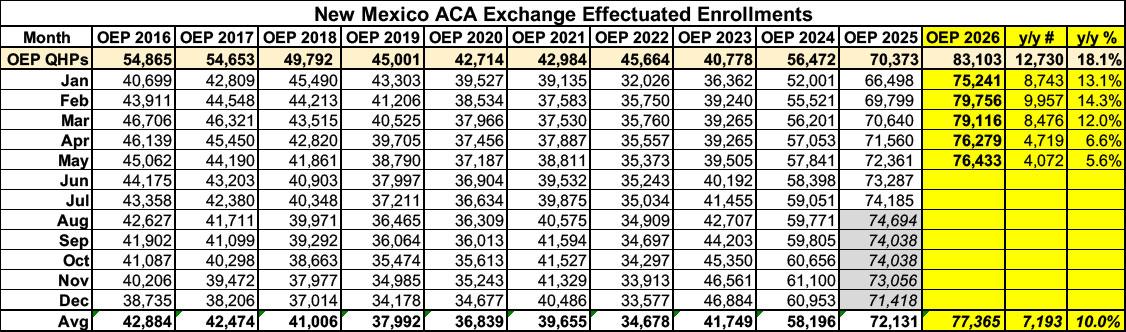
2026 Open Enrollment Period (OEP) enrollment increased by a whopping 18% over OEP 2025, and actual effectuated enrollment has continued to be well above the same month last year...although that year over year increase has been gradually dropping and is only 5.6% higher this month than it was last May. Still, average monthly effectuated enrollment is 10% higher than it was a year ago.
Here's what effectuated enrollment will look like for the rest of the year in Washington assuming it follows either the 2025 or 2019 patterns:
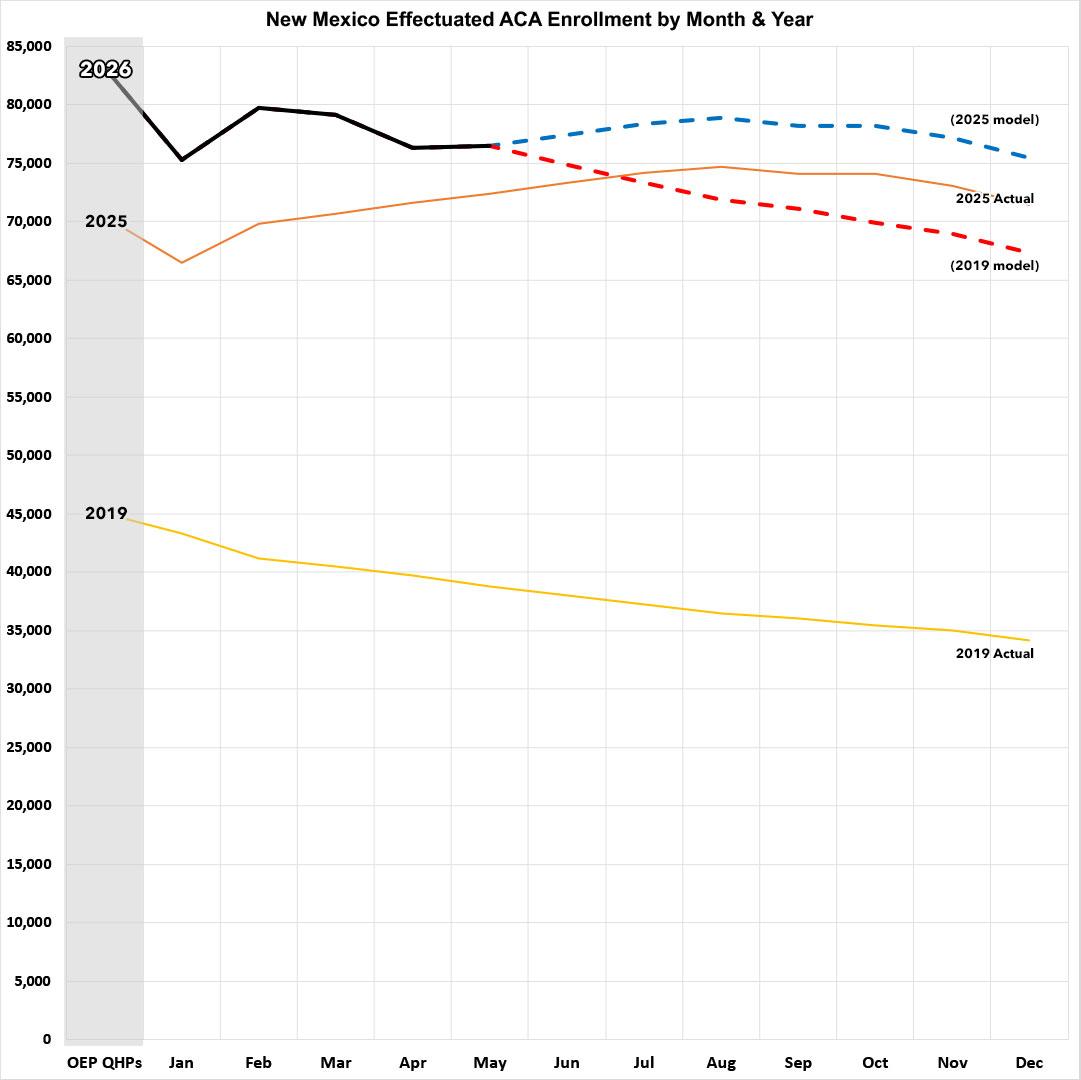
- If the rest of the year follows the 2025 pattern, effectuations will end December at around 75,400 and will average around 77,500 for the year...up 7.5% compared to 2025.
- If the rest of the year follows the 2019 pattern, effectuations will be at around 67,300 by December, and the average for the year will be around 73,600...still up 2.1% y/y.
OK, but what about how comprehensive the coverage is? In pretty much every other state, enrollees have been forced to "buy down" to worse coverage in order to avoid (or at least mitigate) what would otherwise be (and in many cases still are) massive premium hikes.
Not so in New Mexico!
Not only did enrollment at every metal level tier increase (New Mexico doesn't officially offer Catastrophic or Platinum plans)...
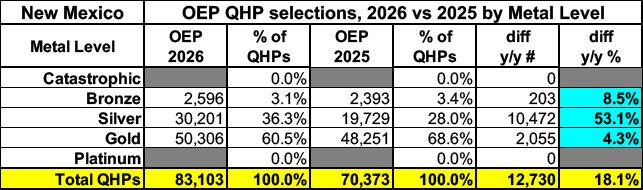
...but here's what it looks like when you break enrollment out by the real world metal tiers, which include's both Cost Sharing Reduction (CSR) assistance as well as New Mexico's supplemental subsidy program, which is branded as "Turquoise Plans" (labeled as T1, T2 & T3 below). The combination of CSR + Turquoise massively boosts the Actuarial Value (AV) of Silver and even Gold plans much higher than "base" Silver or Gold, which typically cover around 70% or 80% of average medical claims.
With the CSR + Turquoise boost, most New Mexico enrollees have 90%, 95% or even 99% of their total costs covered by their policies, which means nominal deductibles, co-pays & coinsurance (out of pocket costs):

In fact, using my own calculations (I'll be writing much more about this soon), it looks to me as if the average AV of 2026 NM enrollees is slightly higher overall than it was in 2025.
Here's what things look like across the 9 states I've run effectuated numbers for. While a few other states saw slight increases in OEP plan selections, New Mexico is the only one so far in which effectuated enrollment is still higher a few months into the year than it was at the same point a year ago:
- California: OEP down 2.6%; February effectuations down 8.5%
- Colorado: OEP down 1.9%; March effectuations down 6.1%
- Georgia: OEP down 12.3%; April effectuations down 28.1%
- Maryland: OEP up 3.4%; April effectuations down 6.3%
- Massachusetts: OEP up 3.7%; April effectuations down 4.3%
- Minnesota: OEP down 8.1%; February effectuations down 8.6%
- New Jersey: OEP down 0.8%; April effectuations down 11.6%
- New Mexico: OEP up 18.1%; May effectuations up 5.6%
- Washington: OEP down 5.9%; February effectuations down 15.7%
In terms of year over year average monthly effectuated enrollment as of the months of the latest data:
- California: Down ~110,000
- Colorado: Down ~13,400
- Georgia: Down ~370,000
- Maryland: Up ~7,000
- Massachusetts: Up ~1,600
- Minnesota: Down ~10,000
- New Jersey: Down ~57,000
- New Mexico: Up ~7,200
- Washington: Down ~33,000
- Total across 9 states: Down at least ~580,000
I'm still working on effectuated data for the remaining states which operate their own ACA exchanges: Connecticut, DC, Idaho, Illinois, Kentucky, Maine, Nevada, New York, Pennsylvania, Rhode Island, Vermont & Virginia...and again, the official effectuated data for every state for the first part of the year likely won't be released by CMS until sometime in July.
Stay tuned...
Advertisement


