


House Dems lay out 2027 healthcare agenda: 80% awesome, 20% murky
Thu, 11/19/2026 - 4:12pm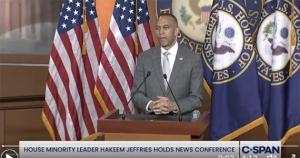
A few days ago, incoming Speaker of the House of Representatives Hakeem Jeffries laid out House Democrats' flagship healthcare legislation for 2027:
Sahil Kapur @sahilkapur.bsky.social
Hakeem Jeffries, likely next House Speaker, calls for a robust health care agenda next year:
- Undoing Trump’s Medicaid cuts
- Restoring enhanced ACA funds
- Lowering Medicare eligibility age
- Adding dental/vision/hearing benefits
- Universal coverage for kids
Now, the first two of these--repealing the Big Ugly Bill's draconian Medicaid cuts and reinstating the enhanced ACA subsidies which expired last year--would go a long way towards repairing/reversing the damage caused by the Trump Regime & MAGA Congress.
I just got done writing up several posts covering the extensive damage being done to Medicaid, and of course I've written ad infinitum about the devastation of Republicans allowing the enhanced tax credits to expire, so I won't rehash those.
Needless to say, I'm 100% onboard with the first two bullet points above.
As for the other three, in reverse order...
Universal Coverage for Kids:
I don't know exactly what they have in mind here, but I'm going to assume that this legislation would be based on New Jersey Senator Andy Kim's "MediKids" bill which he introduced last July. I'm embarrassed to admit that I didn't post anything about this when he announced the bill at the time back in July; I had read about it but never got around to writing about it:
Senator Kim Introduces Landmark “MediKids” Legislation to Guarantee Healthcare for All Children
WASHINGTON, D.C. – Today, Senator Andy Kim (D-NJ), introduced MediKids, monumental legislation guaranteeing healthcare to all children in America from birth to age 26.
First of all, the fact it would cover kids up to age 26 instead of 18 is pretty significant (as a reminder, under the ACA, insurance carriers have to allow young adults to stay on their parents healthcare plans until age 26). Kim said in an interview that he went with 26 because that's the same age that the ACA makes young adults move to their own plan & is what people are used to.
...4.4 million children in America do not have healthcare coverage and 1 in 3 kids is underinsured – meaning about 23 million kids’ healthcare coverage is unable to meet their needs. To provide free, high-quality insurance coverage to every kid, MediKids would automatically enroll every child and young adult in America in Medicaid’s robust Early and Periodic Screening, Diagnostic, and Treatment (EPSDT) benefit, which provides comprehensive and preventive health care services for children who are enrolled in Medicaid. Specifically, this legislation would:
- Automatically enroll every child in MediKids at birth,
- Provide continuous eligibility for children enrolled in MediKids until age 26, regardless of income, immigration status, or health condition; and
- Cover 100% of the federal medical assistance percentage (FMAP) for this population.
Find more information on MediKids here and read the full bill text of the MediKids Act here.
OK, so it would basically automatically enroll every newborn child in Medicaid until they turn 26 years old, with the federal government covering 100% of the cost.
It's important to note that actual enrollment wouldn't actually kick in until two years after the bill was signed into law; the actual text states:
“(X) beginning on the date that is 2 years after the date of enactment of this subclause, who are individuals who have not attained 26 years of age;”.
I figured it would only take one year for the various state agencies/etc (as well as healthcare providers) to prepare for this, but I'm hardly an expert on state Medicaid administrative infrastructure & protocol so if it would take 2 years, so be it.
I should reiterate that I don't know that Sen. Kim's "MediKids" bill is exactly what House Dem leadership has in mind, and even if it is, the version which they actually vote on could look different. For instance, it could be watered down a bit to utilize the Children's Health Insurance Program (CHIP) instead of Medicaid itself (CHIP has more limited coverage and is allowed to include nominal premiums/cost-sharing) if the cost proves to be too much for some House/Senate Dems to swallow.
Alternately, I guarantee "immigration status" would cause a lot of fuss among Republicans and potentially among some Democrats who flipped seats in Republican-leaning districts. With that in mind, I could see the age cut-off being pulled back to 18 instead of 26, since that would make it easier to argue that it would literally be limited to undocumented children, not young adults; since children have no agency re their immigration status, this would make it an easier sell in conservative districts.
If it comes down to covering all kids up to 18 vs. covering citizens/documented residents up to 26 but not covering undocumented kids at all, I'd take the former.
In any event, if they are somehow manage to get this passed and signed into law (or becomes law without Trump's signature) in 2027, as written, this would start covering around 3.6 million newborn babies per year. Of course, around half of all children are already enrolled in either Medicaid or CHIP today, so this would eventually end up enrolling the other half of them in the program.
Dental, Vision & Hearing benefits for Medicare:
Regular readers know that I've criticized Bernie Sanders numerous times over the years for some of his tactics and rhetoric regarding his flagship "Medicare for All" proposal; my biggest gripe is that he has a tendency to handwave some of the larger obstacles to achieving this goal by chalking it all up to "lack of political will" and "greedy corporate interests" when the truth is that while these factors are certainly very real, there are numerous other factors involved as well. However, there's one provision he's been an advvocate of which I'm fully onboard with.
One of the major obstacles I'm talking about is that traditional (aka "fee for service" or FFS) Medicare as it currently stands has several major coverage gaps...gaps which are part of the reason why Medicare Advantage managed to overtake traditional Medicare in market share a year or so ago. The most obvious of these are that FFS Medicare doesn't include coverage for hearing, vision or dental care.
I've never understood why medical services to treat ears, eyes and teeth aren't considered part of the rest of the body by Medicare (to be fair, they're usually not included in private "major medical" insurance policies either), but this is especially problematic given that Medicare is primarily designed for seniors...who are also by far the most likely to require treatment for hearing, vision and dental issues.
Regardless, this is one of the vulnerabilities which privately-administered Medicare Advantage plans take Advantage (pun intended) of: MA plans heavily tout their inclusion of dental, vision and hearing coverage in their advertising.
If your eventual plan is to expand FFS Medicare to as many people as possible, it helps greatly to first beef up how comprehensive it is, and to his credit, Bernie Sanders has been pushing for baking all three of these into it for a long time.
In addition to making FFS Medicare far more comprehensive, this would also bring it much closer to coverage parity with Medicare Advantage plans, eliminating much of the reason new enrollees might choose them over the traditional version.
FWIW, back in 2019, the Congressional Budget Office (CBO) published an analysis which found that...
Policymakers are considering adding dental, hearing, and vision benefits to Medicare as part of the budget reconciliation bill – a change that would be the largest expansion of Medicare benefits since the Part D drug benefit was launched in 2006.
These program improvements would lead to higher federal spending of $358 billion over 10 years (2020-2029), including $238 billion for dental and oral health care, $89 billion for hearing care, and $30.1 billion for vision care, according to a Congressional Budget Office estimate of the version of H.R.3 passed by the House in 2019.
Additionally, in a July 2021 executive order, President Biden called for the Secretary of Health and Human Services to issue a proposed rule that would allow hearing aids to be sold over-the-counter, as allowed under the FDA Reauthorization Act of 2017 – a move that could help make hearing aids more affordable for people with hearing difficulties who may be foregoing purchasing them due to cost.
Expanding Medicare coverage for dental, hearing, and vision services and making lower-cost hearing aids available would address significant gaps in coverage and could alleviate cost concerns related to these services for people on Medicare.
Keep in mind that if the CBO were to run a similar analysis today, hearing aide expenses might actually be lower thanks to President Biden making them available over the counter...but dental/oral and vision care coverage would likely be far higher given that we're talking about adding 9 years of medical inflation in (and that would include both COVID-era and Trump Tariff-era inflation, I should note). Even using general inflation would bring this up to $310 billion over a decade using 2026 as the baseline; if you start with 2028 I'd imagine it would be $330 - $350B or so.
Coming up with the funding would presumably be included in whatever bill Democrats pass, of course, but if they're serious about moving towards anything resembling M4A, adding dental, vision & hearing coverage to the mix would be an important major step.
Lowering Medicare eligibility age:
Finally, we get to perhaps the "sexiest-sounding" of these provisions...which is also, unfortunately, the most complicated and, as I'll explain below, the one with the most questionable overall benefit.
Again, the bullet points included in Jeffries' statement don't include any details, but the assumption is that the eligibility age for enrolling in Medicare would be reduced from the current 65 down to either 55 or 50; the exact age range is unknown. Also unknown is whether they'd enroll with the same premiums, co-pays, deductible etc. that current Medicare enrollees have or whether they'd have to pay higher monthly premiums.
I should note that none of this is remotely new. Hillary Clinton made allowing people age 55+ to enroll in Medicare one of the cornerstones of her own healthcare plan over a decade ago, and since then there have been several different bills along these lines introduced by various Democratic Senate & House members.
The most recent one was submitted just a few weeks ago by Wisconsin U.S. Senator Tammy Baldwin, co-sponsored by 9 of her Democratic colleagues; it's simply called "Medicare at 50:"
Medicare at 50 Act would give more than 58 million Americans ages 50 to 64 another option for affordable health care
WASHINGTON, D.C. – As her first bill after the Midterm election, U.S. Senator Tammy Baldwin (D-WI) led a group of her colleagues in introducing the Medicare at 50 Act, legislation to lower the Medicare eligibility age to 50 and allow Americans ages 50 to 64 to buy into Medicare. As Americans list the cost of health care as a top concern, Baldwin’s bill will expand access to affordable health care and give more than 58 million Americans more coverage options.
...More than 60 million Americans are between the ages of 50 and 64, a population that faces significant challenges accessing affordable, comprehensive health insurance. While the Affordable Care Act (ACA) expanded access to coverage, millions of older Americans continue to face high premiums, out-of-pocket costs, and limited coverage options. Today, 11.5 percent of uninsured Americans are between the ages of 55 and 64.
President Trump and Republicans have made matters worse with sweeping health care cuts in their Big Ugly Bill and their refusal to extend the ACA’s enhanced premium tax credits, driving up costs for older Americans who purchase insurance through the ACA Marketplace. In 2026, premiums for Americans ages 50 to 64 purchasing insurance through the ACA Marketplace doubled, while enrollment among this population fell by 6%.
The Medicare at 50 Act would help close this gap and give Americans between the ages of 50 and 64 the option to buy into Medicare before reaching the traditional eligibility age of 65. Individuals who choose to enroll would receive the same benefits and protections available under Medicare Parts A, B, and D, including the option to enroll in a Medicare Advantage plan. The legislation would also allow eligible individuals to receive the same premium tax credits and cost-sharing subsidies they would qualify for through the ACA Marketplace, helping make coverage more affordable.
OK, there's several things to note here: First, it would start at age 50 and up, making it the most sweeping proposal of the various non-universal plans of this nature I've seen.
Second, judging by the wording in the legislative text itself, the premiums would be based on the cost of coverage for the 50 - 64 yr old population only (note the "under this section" caveats):
‘‘(1) AMOUNT OF MONTHLY PREMIUMS.—The Secretary shall (beginning for the first year that begins more than 1 year after the date of the enactment of this section), during September of the preceding year, determine a monthly premium for all individuals enrolled under this section. Such monthly premium shall be equal to 1 ⁄12 of the annual premium computed under paragraph (2)(B), which shall apply with respect to coverage provided under this section for any month in the succeeding year.
‘‘(2) ANNUAL PREMIUM.— ‘‘(A) COMBINED PER CAPITA AVERAGE FOR ALL MEDICARE BENEFITS.—The Secretary shall estimate the average, annual per capita amount for benefits and administrative expenses that will be payable under parts A, B, and D (including, as applicable, under part C) in the year for all individuals enrolled under this section.
‘‘(B) ANNUAL PREMIUM.—The annual premium under this subsection for months in a year is equal to the average, annual per capita amount estimated under subparagraph (A) for the year.
This is important because it means that the 50 - 64 yr old population would be part of a separate risk pool from 65+ Medicare enrollees. This is either good or bad depending on your POV: It would make the full cost of premiums less expensive for this population than for those 65+, but it would also require establishing a whole new & separate administrative and payment infrastructure parallel to the existing Medicare Trust Fund:
‘‘(2) DEPOSIT INTO MEDICARE BUY-IN TRUST 22 FUND.—Amounts collected by the Secretary under this section shall be deposited in the Medicare Buy In Trust Fund established under paragraph (3).
‘‘(3) MEDICARE BUY-IN TRUST FUND.— ‘‘(A) IN GENERAL.—There is hereby created on the books of the Treasury of the United States a trust fund to be known as the ‘Medicare Buy-In Trust Fund’ (in this paragraph referred to as the ‘Trust Fund’). The Trust Fund shall consist of such gifts and bequests as may 7 be made as provided in section 201(i)(1) and such amounts as may be deposited in, or appropriated to, such fund as provided in this title.
OK, so the full-price premiums would be calculated by dividing the total cost of benefits by the total number of enrollees. Of course traditional Medicare is heavily subsidized via its own formula, but instead of using that, this bill proposes to use the ACA benchmark plan tax credit formula for subsidizing enrollees age 50 - 64:
‘(f) ELIGIBILITY FOR FINANCIAL ASSISTANCE.— ‘‘(1) IN GENERAL.—Individuals enrolled in coverage under this section shall, from amounts transferred under paragraph (2), receive financial assistance for such coverage that is substantially similar to the assistance the individual would have received if the individual were enrolled in a qualified health plan through an Exchange.
...The amounts transferred to the Medicare Buy-In Trust Fund under subparagraph (A) shall only be used to reduce the premiums and cost-sharing for coverage under this section of individuals enrolled under such coverage who would be eligible for cost-sharing reductions under section 1402 of the Patient Protection and Affordable Care Act and premium assistance under section 36B of the Internal Revenue Code of 1986 if such individual were enrolled in a qualified health plan.
In other words...
...Coverage provided through enrollment under this part and parts B and D pursuant to this section shall be treated as coverage under a qualified health plan in the silver level of coverage in the individual market offered through an Exchange and the Secretary shall be treated as the issuer of such plan.
This basically means that for purposes of this population only, Medicare will be treated as if the enrollee had selected a Silver ACA policy, thus making them legally eligible for the same ACA subsidies that they would if they had enrolled in the actual benchmark Silver ACA policy. Of course technically the benchmark plan is specifically the 2nd lowest-cost Silver plan available on the actual ACA exchange, but the point is that enrollees who earn between 100 - 400% FPL would be limited to paying no more than 2.15% - 10.22% of their household income in net premiums, and if their household income is below 250% FPL they'd also be eligible for Cost Sharing Reduction (CSR) assistance as if they had enrolled in a Silver ACA exchange plan.
The Baldwin bill does include some restrictions on this population:
- They wouldn't be eligible for Medicare Cost-Sharing Assistance
- States would be prohibited from buying their Medicaid enrollees age 50 - 64 into Medicare utilizing this bill
- Enrollees would still be eligible to enroll in Medigap policies, which typically cover Medicare co-pays, coinsurance and deductibles
At face value, this seems reasonable...but Merrill Goozner makes some important points which raise the question of whether it would really be worth going through all the trouble involved in establishing this particular provision:
...What if [Trump] signs legislation that fails to provide much relief from high health care costs for its target population? In the case of the Medicare buy-in contained in S.5700, it’s unclear that it will. One thing’s for certain, it will engender widespread opposition from health care providers.
...The Baldwin bill provides the opportunity to buy into the Medicare program as it currently exists for two specific groups: The nearly 7 million people out of the 60 million adults between 50 and 64 who are uninsured...and anyone in that age bracket who currently buys private plans on the Affordable Care Act exchanges.
...In 2026, the average employer-sponsored health plan cost $817 a month for individuals and $2,359 a month for families, according to the Kaiser Family Foundation’s most recent annual employer survey. And that coverage usually includes thousands of dollars annually in deductibles and co-pays.
The next available set of options people have are on the ACA exchanges...The average cost of an individual plan for a 60-year-old, according to the Peterson-KFF Health System Tracker, is $1,326 a month with an annual average deductible of over $5,300.
...The loss of the Biden-era enhanced premium tax credits is hitting older purchasers of ACA plans hard. About a third of all ACA enrollees are between 50 and 64. Those earning over $65,000 a year next year will have to pay 100% of the premium, nearly tripling their upfront costs, according to the Kaiser Family Foundation.
...The idea of a Medicare buy-in for these folks does seem compelling on the surface. The general public loves Medicare without knowing much about its flaws. Yet Baldwin bill doesn’t use the existing program. Rather, it...creates a separate risk pool for these older workers, who are the most expensive to care for among the working-age population.
Goozner notes that if Baldwin's bill used existing Medicare buy-in rules, a typical 50-64 enrollee would have to pay between $804 - $1,000/month in premiums...while still having to pay co-pays, deductibles and coinsurance. In other words, it would be comparable to the cost of COBRA (limited to 18 months) and somewhat less expensive than an ACA plan without the enhanced subsidies which expired last December.
So...not bad, but probably not worth creating a whole new administrative infrastructure which would also cause a lot of disruption to the existing system. This leads to problem #2: The reimbursement rates for healthcare providers...which would be a major issue for any expansion of Medicare eligibility whether you're talking about adding 60 yr olds, 55 yr olds, 50 yr olds or everyone in the country:
...Those rates are about 40% on average of what private insurers pay. To the extent people were switching from ACA plans or opting into Medicare after losing their job where they had employer-provided coverage, providers could wind up picking up some fraction of the cost through reduced revenue.
Again: Part of the reason why Medicare rates can be so inexpensive is because private insurance rates are so expensive. Medicare is essentially a loss leader for most hospitals, doctors etc so they have to make up for it by negotiating high reimbursement rates with private insurance carriers.
As for the clever provision to treat the 50+ Medicare enrollees as if they had enrolled in a Silver ACA plan for purposes of receiving tax credits:
It’s impossible to calculate in advance how this might shake out as an unsubsidized premium cost for potential buyers-in who earn over 400% of poverty ($63,840 in 2026). The plan will be paying lower rates. But the risk-pool will be filled with older, sicker people, the most expensive to cover within the working age population.
Yes, it will decrease the role of the insurance industry and its profits. But it adds to administrative inefficiency by creating another billing program for hospital and physician office administrators. Those new costs will be layered on top of the reduced reimbursement for their services.
Such a bill will generate just as much political opposition from the medical-industrial complex as some broader reform. Is this further fragmentation of the risk pool really worth it? This isn’t where I’d start when looking to put something meaningful for the broader population on Trump’s desk.
It's important to note that the Baldwin Medicare at 50 bill operates on the assumption that the enhanced tax credits aren't resinstated and made permanent. IF this is the case, then offloading ACA enrollees aged 50+ makes a lot more sense, since the remaining subsidies are a lot stingier for those earning less than 400% FPL and don't exist at all for those over 400% FPL (which includes a high portion of those over 50 yrs old).
HOWEVER, one of the other top priorities for Congressional Democrats is, indeed, reinstating the enhanced subsidies and presumably making them permanent.
This means that a 60-yr old earning $65,000/year (just over 400% FPL) would be paying just $460/month for the benchmark Silver plan on the actual ACA exchange...vs. paying the exact same $460/month for Medicare.
Now, it's true that traditional Medicare has an average actuarial value of around 85% while the benchmark Silver plan has an average AV of around 70%...but I believe Medicare's 85% rating is also based on Medicare reimbursement rates.
As an aside, ACA plans also have a major advantage not included in FFS Medicare: A maximum out of pocket (MOOP) expense cap. Granted, that cap is pretty steep ($11,000/yr for a single adult, $22,000/yr for a family) but that's still a lot better than having no ceiling on potential expenses whatsoever, as is the case with traditional Medicare (FFS Medicare Part D has a $2,400/yr cap on prescription drug expenses thanks to the Inflation Reduction Act, but that doesn't apply to other medical services).
The bottom line is that if the enhanced ACA subsidies are indeed reinstated and made permanent, there doesn't seem to be much point in also creating a whole new complicated administrative infrastructure for Medicare as well...and if they aren't reinstated, then older enrollees over 400% FPL also wouldn't see a massive cost savings from the current Medicare benefit system either.
If, on the other hand, hearing, vision & dental coverage is indeed added to traditional Medicare as well as an overall out of pocket expense cap (to bring it into parity with both ACA coverage and Medicare Advantage plans), then lowering Medicare eligibility to 50+ makes a lot more sense to me...although that would still leave the reimbursement rate issue.
In the end, I'm not saying that we shouldn't lower Medicare eligibility to 50. I'm saying that we should significantly beef up traditional Medicare FIRST (by adding dental, hearing, vision and MOOP) along with reinstating the subdiies, let those provisions get baked into the healthcare system for a couple of years, and then unleash phase one of a Medicare buy-in Public Option.
Of course that doesn't mean a Baldwin-like bill can't be passed next year; it could just include trigger language stating that it would only be effectuated, say, 2 years after the other provisions go into effect first.
To put it in Thanksgiving terms: Before you invite more members of your family over for dinner, you should probably make sure you clean up the house & have enough food to eat first.
Advertisement


