WASHINGTON—Vice President JD Vance’s antifraud task force is set to remove hundreds of thousands of enrollments from the Affordable Care Act’s public exchanges, saying those enrollees don’t meet eligibility requirements or don’t exist at all.
...Vance and Dr. Mehmet Oz, the administrator for the Centers for Medicare and Medicaid Services, or CMS, are set to announce they are canceling subsidy payments for allegedly unauthorized and fraudulent enrollments in the ACA, also known as Obamacare, for 760,000 individual accounts, according to administration officials. They say those cancellations would amount to saving an estimated $2.2 billion in taxpayer funds.
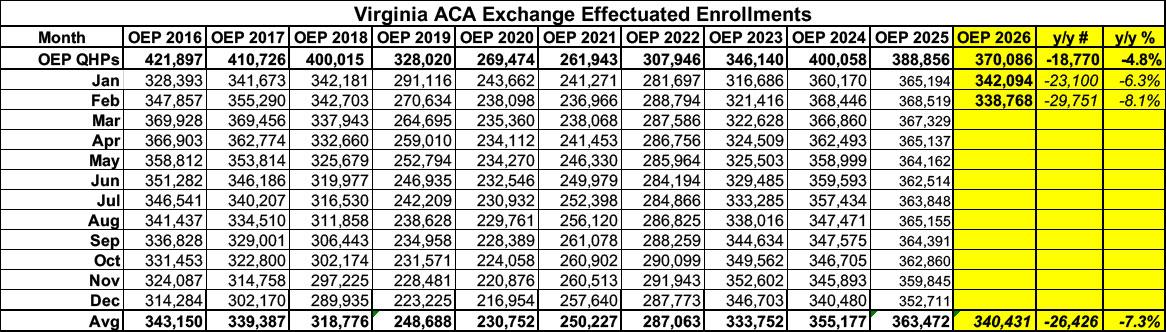
ACA exchangeenrollment has dropped by 8% in Virginia since Congressional Republicans allowed the enhanced federal subsidies to expire at the end of last year.
Initial signups during Open Enrollment were only down ~5% vs. OEP 2025...but effectuated enrollment was down 6.3% year over year as of January and 8.1% as of February.
That's nearly 30,000 Virgnians who lost healthcare coverage in the first two months of the year.
Here's what this looks like visually, with both 2025 and 2019 (the last pre-COVID year, which didn't include the enhanced subsidies) included for comparison:
Before I begin, it's important to note that ACA exchange enrollment has dropped in Pennsylvania since Congressional Republicans allowed the enhanced federal subsidies to expire at the end of last year...although thanks to the state implementing fairly robust Premium Alignment pricing, it's not nearly as dramatic a drop-off as in most other states.
Initial signups during Open Enrollment were actually slightly higher than last year...but effectuated enrollment began to drop starting in February and has continued to drop at an increasing rate every month since then. As of July 2026, effectuated enrollment is down more than 10% vs. a year earlier, and it's down nearly 4% on average for the year so far. That's 48,000 fewer Pennsylvanians with ACA exchange coverage as of July:
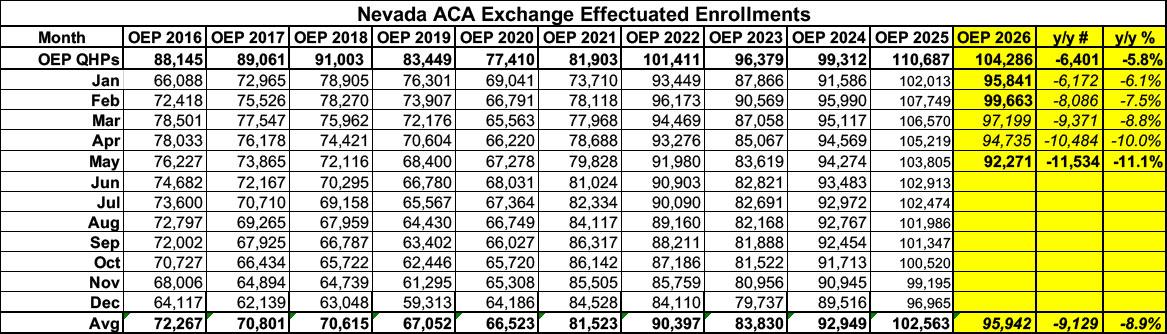
ACA exchange enrollment has dropped by 11% in Nevada since Congressional Republicans allowed the enhanced federal subsidies to expire at the end of last year.
Initial signups during Open Enrollment were only down ~6% vs. OEP 2025...but effectuated enrollment has gradually shrunk further every month since then and stood at 11.1% lower as of May 2026.
That's over 11,000 Nevadans who have lost coverage so far this year.
Here's what this looks like visually, with both 2025 and 2019 (the last pre-COVID year, which didn't include the enhanced subsidies) included for comparison:
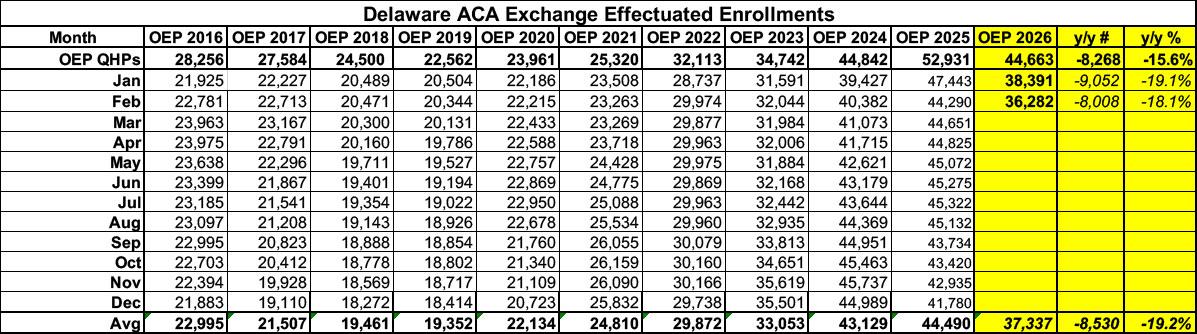
ACA exchange enrollment has dropped by 18% in Delaware since Congressional Republicans allowed the enhanced federal subsidies to expire at the end of last year.
Initial signups during Open Enrollment were already down over 15% vs. OEP 2025...and effectuated enrollment has continued to slip to the point that it was 18% lower in February 2026 than a year earlier.
Here's what this looks like visually, with both 2025 and 2019 (the last pre-COVID year, which didn't include the enhanced subsidies) included for comparison:
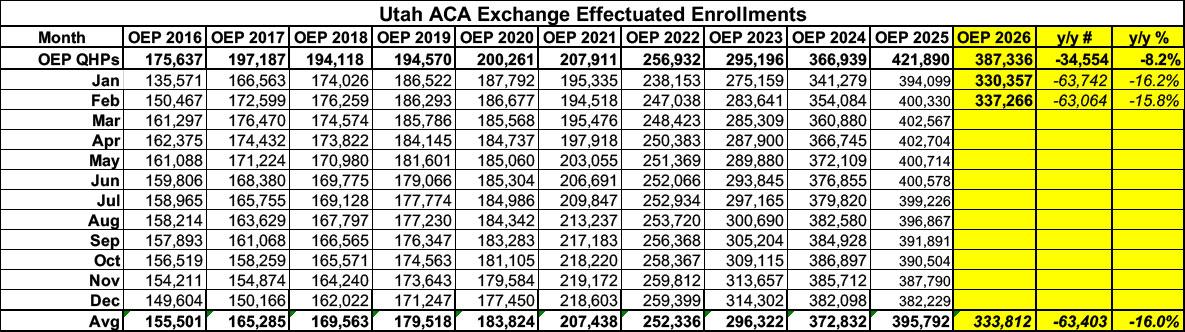
ACA exchange enrollment has dropped by 16% in Utah since Congressional Republicans allowed the enhanced federal subsidies to expire at the end of last year.
Initial signups during Open Enrollment were down 8% vs. OEP 2025...but the drop in effectuated enrollmentdoubled in the first two months of the year, to around 16% lower vs. the same point a year earlier.
That's over 63,000 Utahns who already lost coverage in just the first two months...a number which has likely continued to climb since then.
Here's what this looks like visually, with both 2025 and 2019 (the last pre-COVID year, which didn't include the enhanced subsidies) included for comparison:
Before I begin, it's important to note that ACA exchange enrollment has dropped in Hawaii since Congressional Republicans allowed the enhanced federal subsidies to expire at the end of last year. Fortunately, the raw number of enrollees who have lost coverage is pretty small due to:
a) Hawaii only having around 1.4 million residents to begin with and
b) Hawaii having a much more robust Employer-Sponsored Health Insurance mandate law than the ACA. Under the Hawaii Prepaid Health Care Act of 1974, employers are required to offer coverage to employees working at least 20 hours per week. In contrast, the federal Patient Protection and Affordable Care Act requires employers to offer coverage to employees working at least 30 hours per week.
As a result, Hawaii's individual/nongroup health insurance market is smaller as a percentage of the total population than it is in most other states.
RETURNING BIDEN OVERCHARGES TO WORKING FAMILIES: Today, President Donald J. Trump announced that the federal government will return to the American people hundreds of millions in Obamacare overcharges, collected by the Biden Administration, by issuing refunds of $500 per person to nearly 1 million Americans in 30 states. Today’s actions directly refund the Americans most exposed to the higher costs imposed by the Biden Administration’s gross mismanagement of Obamacare.
So what the hell is this all about? Let's take a look, shall we?
Thirteen health insurers request average 22.4% rate increase for 2027 individual market
OLYMPIA, Wash. — Thirteen health insurance companies have requested an average rate change of 22.4% for Washington state’s 2027 individual health insurance market. Insurers base requested rate changes on assumptions made about the services their policyholders will use and the cost to deliver that care.
“I know the requested rate changes will be difficult for individuals and families,” said Insurance Commissioner Patty Kuderer. “We’re going to spend the next several months reviewing every assumption made by the insurers to make sure their requests are justified.”
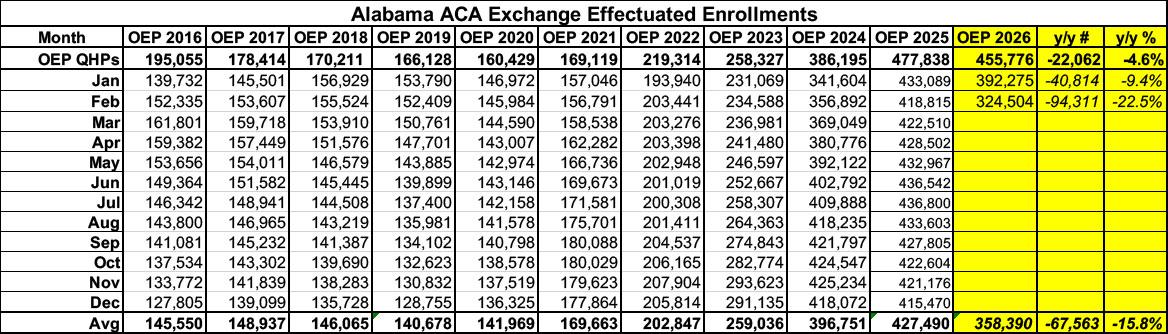
ACA exchange enrollment has dropped by nearly 23% in Alabama since Congressional Republicans allowed the enhanced federal subsidies to expire at the end of last year.
Initial signups during Open Enrollment were already down 4.6% vs. OEP 2025...buteffectuated enrollment as of January 2026 was down over 9% year over year...increasing to a 22.5% drop as of February.
That's over 94,000 Alabamans who already lost coverage in just the first two months of the year...a number which has likely continued to climb since then.