


2027 Rate Changes - Ohio: +13.0% indy market; +16.4% sm. group market
Thu, 08/27/2026 - 9:08am
ACA exchange enrollment has dropped by 32% in Ohio since Congressional Republicans allowed the enhanced federal subsidies to expire at the end of last year.
Initial signups during Open Enrollment were down nearly 20% vs. OEP 2025...but effectuated enrollment dropped further, by 23% year over year in January and by over 32% in February.
That's over 160,000 Ohioans who already lost coverage in just the first two months of the year...a number which has likely continued to climb since then.
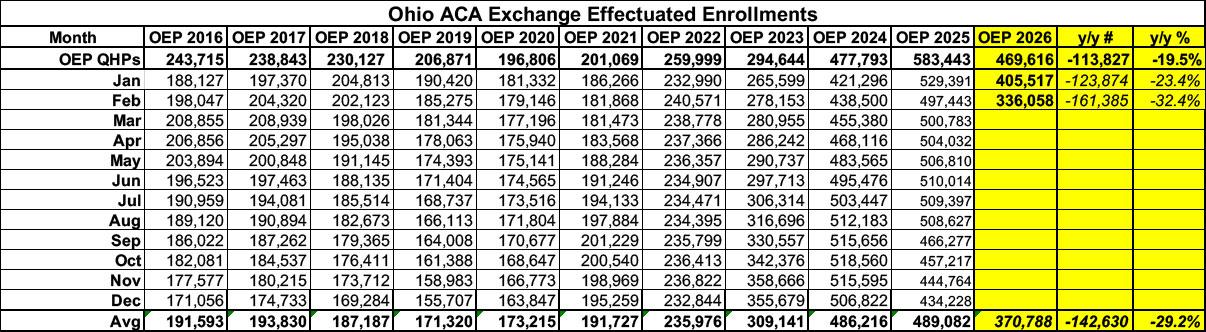
Here's what this looks like visually, with both 2025 and 2019 (the last pre-COVID year, which didn't include the enhanced subsidies) included for comparison:

Looking ahead to 2027, the preliminary rate filings for both the individual and small group markets are now available via the federal Rate Review database:
ANTIDOTE:
Antidote’s average proposed rate increase of 15.80%, effective January 1, 2027, is expected to impact 30,508 members based on May 2026 membership. The rate increase is the same for all adult members within a given plan, though it varies by plan, ranging between 11.05% and 26.60%. Rate changes vary by plan due to the impact of changes in benefits and changes to the Cost Sharing Reduction (CSR) shortfall load.
Financial Experience of the Product
Antidote’s 2025 experience is shown in the URRT included with the 2027 rate filing, with a reported loss ratio of 115.5% in URRT Worksheet 2, Section II. The requested rate increases are expected to result in a loss ratio of 93.0% in 2027 using the methodology prescribed by 45 CFR 158.
Changes in Medical Service Costs
Medical trend for these products is anticipated to be an average of 7.5% per year on allowed claims. Medical trends include a combination of utilization and costs of services. This is an increase in annual trend from the 2026 rate development and is included in the calculation of the rate increase.
Morbidity
We include a morbidity increase to claims relative to Antidote’s experience to account for the expiration of enhanced subsidies at the end of the 2025 plan year, consistent with current regulations. This adjustment results in a net 6.1% increase to the experience rate.
Risk Adjustment
We include a risk adjustment transfer payment based on Antidote’s anticipated competitive position in 2027. We expect new enrollees to have a health status similar to the Ohio statewide average, but given Antidote has no prior experience with these new members, we anticipate Antidote will have less ability to fully capture all applicable diagnoses information. We expect this will ultimately lead to a payable into the risk adjustment program for 2027.
Retention
We include retention as provided by Antidote for 2027, including a federal exchange fee decrease relative to 2026.
BUCKEYE COMMUNITY/AMBETTER:
Estimated Average Annual Premium
The estimated average annual premium per policy in calendar year 2027 is x x x .
(Unfortuantely, Buckeye has redacted both their average premium increase as well as their effectuated enrollment number, although the former is at least available at the federal rate review database).
Distribution of Business
See Appendix 1.2 for the expected age and geographic distributions for these products.
Rate Tables
See Appendix 1.3 for allowable rating factors and Appendices 1.3b and 1.3c for clarification on service area definitions. Appendix 1.4 also includes an example of how rating factors will be applied. Note that for family coverage, rates for children are charged to no more than the three oldest covered children under age 21 consistent with the Family Structure rules of the Patient Protection and Affordable Care Act (ACA).
Impact of eAPTC Expiration
To account for eAPTC expiration prior to the 2027 benefit year, we have assumed rates will increase due to anticipated reductions in enrollment, both at the issuer and single risk pool level. As eAPTCs expire and enrollees subsequently face increased out-of-pocket premiums, we assume healthier individuals who tend to be more price sensitive will leave the market, worsening the average morbidity of the individual risk pool.
BUCKEYE HEALTH PLAN:
Estimated Average Annual Premium
The estimated average annual premium per policy in calendar year 2027 is XXXXX
(Unfortuantely, Buckeye has redacted both their average premium increase as well as their effectuated enrollment number, although the former is at least available at the federal rate review database).
Distribution of Business
See Appendix 1.2 for the expected age and geographic distributions for these products.
Rate Tables
See Appendix 1.3 for allowable rating factors and Appendices 1.3b and 1.3c for clarification on service area definitions. Appendix 1.4 also includes an example of how rating factors will be applied. Note that for family coverage, rates for children are charged to no more than the three oldest covered children under age 21 consistent with the Family Structure rules of the Patient Protection and Affordable Care Act (ACA).
Impact of eAPTC Expiration
To account for eAPTC expiration prior to the 2027 benefit year, we have assumed rates will increase due to anticipated reductions in enrollment, both at the issuer and single risk pool level. As eAPTCs expire and enrollees subsequently face increased out-of-pocket premiums, we assume healthier individuals who tend to be more price sensitive will leave the market, worsening the average morbidity of the individual risk pool.
CARESOURCE OHIO:
Individual Market Withdrawal Notification
1. Description of Withdrawal Plan and Scope
CareSource will discontinue its Individual Market health insurance products in the State of Ohio.
a. Products Affected
CareSource will withdraw all Individual Market products, including both On-Exchange and Off-Exchange ACA-compliant plans offered in Ohio. This withdrawal does not apply to other lines of business, including Medicaid, Medicare, or other non-Individual market offerings.
b. Reason for Withdrawal
CareSource has undertaken a comprehensive evaluation of its Individual Market business and broader organizational strategy. Based on this review, CareSource has made the decision to exit the Ohio Individual Market to align resources with long-term strategic priorities and ensure continued focus on sustainable lines of business.
c. Timeline and Effective Dates
• Withdrawal effective date: January 1, 2027
• Coverage termination date: December 31, 2026d. Replacement Coverage
CareSource will not offer replacement Individual Market coverage to affected members in Ohio. Members will be directed to HealthCare.gov to evaluate available coverage options from other issuers during the applicable Open Enrollment Period.
e. Other Jurisdictions
This withdrawal applies specifically to the Ohio Individual Market. CareSource’s participation in other states and lines of business is evaluated independently and may differ.2. Product Form Identification All forms associated with the products being discontinued, including policy forms, evidences of coverage, and schedules of benefits, are provided in Exhibit A.
3. Affected Enrollment
As of 05/26/26: 28,319 (27,095 on exchange, 1,224 off-exchange)
4. Efforts to Market Book of Business
CareSource evaluated the feasibility of marketing the affected Individual Market block of business to other insurers. Based on this assessment, CareSource has determined that, due to the size, composition, and strategic considerations associated with the block, it is not pursuing efforts to market the book of business to affiliated or non-affiliated insurers.
COMMUNITY INSURANCE (ANTHEM):
Community Insurance Company (also referred to as Anthem) has made an application to the Ohio Department of Insurance for premium rate changes for its fully ACA-compliant individual health plan products. This increase will impact approximately 73,000 Ohio insured members renewing in 2027 with Anthem. At the individual plan level, rate increases range from 12.05% to 23.62%. An individual’s actual rate could be higher or lower depending on the geographic location, age characteristics, dependent coverage and other factors.
Financial Experience
Anthem expects the proposed rate increase will cover projected medical trends and yield a medical loss ratio of 87.21%, meaning more than eighty-seven cents of each premium dollar are expected to go to covering our members’ medical expenses and improving health care quality. This projected MLR of 87.21% exceeds the minimum MLR requirement of 80% as defined in the Affordable Care Act (ACA). In the event Anthem’s MLR is less than the Federal required minimum for a three year period, Anthem will refund the difference to policyholders, consistent with federal regulations.
Drivers of Rate Increase
The primary drivers of premium increases are associated with increased cost of benefit expense for this ACA compliant block. Increased cost of benefit expense is driven by increases in the price of services primarily from hospitals, physicians and pharmacies, coupled with members increasing their use of health care services, also called “utilization”. Increases in the price of services are driven by technological advances, new specialty medications, and a variety of other factors. Increased utilization is driven by member level utilization and selection patterns in the Guaranteed Issue, Community Rated ACA market.
Efforts to Control Costs
Anthem is committed to working to hold down the cost of insurance and price the Individual ACA market for long term sustainability. We continue to explore innovative collaboration with providers and negotiate deeper discounts at our hospitals. We provide members with tools to make informed decisions about where and how to receive treatment. Despite these efforts to moderate the cost of insurance, the cost of benefit expense in the Individual ACA market has continued to rise. In light of emerging costs, 2027 premium increases are needed to price Anthem’s ACA-compliant Individual health plan products for long term sustainability.
MEDICAL HEALTH INSURING CORP:
For Individual ACA plans effective January 1, 2027, MMO is proposing an overall average increase of 21.6% for existing plans, potentially impacting up to 3,113 current MMO members. This rate increase is based on actuarial projections, and results may differ from these projections as actual experience deviates from the rating assumptions.
Items impacting the proposed rate increase include:
- Increase in medical and drug costs are projected at 7.0% annually
- Changes in demographics and morbidity of the risk pool
- An increase in MMO’s projected risk adjustment transfer payment
- The profit and risk is projected to increase $21.03 PMPM. The taxes and fees are projected to increase $13.38 PMPM due to MMO marketing On-Exchange plans in 2027.
The projected loss ratio is 80.11%, which satisfies the federal minimum loss ratio requirement of 80.0%.
MOLINA:
Molina Healthcare of Ohio, Inc. is a managed care organization that provides healthcare services to individuals eligible for Medicaid, Medicare, and Marketplace throughout the State of Ohio. Molina Healthcare of Ohio, Inc. is a licensed state health plan managed by its parent corporation, Molina Healthcare, Inc.
1. Scope and range of the rate increase: Molina’s proposed rates represent an average rate increase of 19.5% for the 32 Molina members enrolled in continuing plans effective May 2026.
2. Financial experience of the product: The proposed premium rates yield a medical loss ratio of 89.8%. The medical loss ratio represents the percentage of every premium dollar that Molina expects to spend on medical expenses and improving health care quality for our members. The projected medical loss ratio of 89.8% exceeds the Affordable Care Act minimum required loss ratio of 80.0%.
3. Changes in Medical Service Costs: Medical inflation related to the utilization and cost of covered services increased claims by 8.5%. Trend is one of the primary contributors to an increase in rates. Changes in provider contracting rates also contributes to rate change.
4. Changes in Benefits: In 2027, the impact on rates from benefit design changes for all renewal plans is minimal.
5. Administrative Costs and Anticipated Margins: Total administrative expenses are expected to contribute toward -2.2% of premium change. The targeted profit margin remains 3.0% of premium.
OSCAR BUCKEYE STATE:
The purpose of this document is to present rate change justification for Oscar Buckeye State Insurance Corporation (Oscar’s) Individual Affordable Care Act (ACA) products, with an effective date of January 1, 2027, and to comply with therequirements of Section 2794 of the Public Health Service Act as added by Section 1003 of the Patient Protection and Affordable Care Act (ACA).
Using in-force business as of May 2026, the proposed average rate increase for renewing plans is 18.0%. Rate changes vary by plan due to a combination of factors including shifts in benefit leveraging and cost-sharing modifications. This rate decrease is absent of rate changes due to attained age. The rate increase impacts an estimated 77,548 members.
2. Reason for Rate Increase(s)
The significant factors driving the proposed rate change include the following:
Medical and Prescription Drug Inflation and Utilization Trends
The projected premium rates reflect the most recent emerging experience which was trended for anticipated changes due to medical and prescription drug inflation and utilization.
Administrative Expenses, Taxes and Fees, and Risk Margin
Changes to the overall premium level are needed because of required changes in federal and state taxes and fees. In addition, there are anticipated changes in both administrative expenses and targeted risk margin.
Prospective Benefit Changes
Plan benefits have been revised as a result of changes in the Center for Medicare and Medicaid Services (CMS) Actuarial Value Calculator and state requirements, as well as for strategic product considerations.
Anticipated Changes in the Average Morbidity of the Covered Population
Changes to the overall premium level are needed because of anticipated changes in the underlying morbidity of the projected marketplace.
Anticipated Changes in the Network Configuration
Changes to the overall premium level are needed because of anticipated changes in the underlying network configuration and associated unit costs.
OSCAR INSURANCE CORP:
Exhibit A summarizes the proposed rate increases by plan effective January 1, 2027. Rate increases vary by plan due to a combination of factors including shifts in benefit leveraging, cost-sharing modifications, and geographic rating factors.
Using in-force business as of May 2026, the proposed average rate change for renewing plans is XXXXX . This rate change is absent of rate changes due to attained age.
(Unfortunately, Oscar Insurance Corp. has redacted both their average premium increase as well as their effectuated enrollment number, although the former is at least available at the federal rate review database).
The significant factors driving the proposed rate change include the following:
Medical and Prescription Drug Infl ation and Utilization Trends
The projected premium rates reflect the most recent emerging experience which was trended for anticipated changes due to medical and prescription drug inflation and utilization.
Administrative Expenses, Taxes and Fees, and Risk Margin
Changes to the overall premium level are needed because of required changes in federal and state taxes and fees. In addition, there are anticipated changes in both administrative expenses and targeted risk margin.
Prospective Benefi t Changes
Plan benefits have been revised as a result of changes in the Center for Medicare and Medicaid Services (CMS) Actuarial Value Calculator and state requirements, as well as for strategic product considerations.
Anticipated Changes in the Average Morbidity of the Covered Population
Changes to the overall premium level are needed because of anticipated changes in the underlying morbidity of the projected marketplace.
PARAMOUNT INSURANCE CO:
Paramount Insurance Co. was acquired by Medical Mutual of Ohio in 2024 but still had around 2,200 ACA exchange enrollees as of spring 2025. I'm operating on the assumption that these have been either phased out or absorbed into the enrollment of Medical Health Insuring Corp. of Ohio (Medical Mutual) above.
SUMMA INSURANCE CO:
Qualified Health Plan Issuers are requested to post a justification for a rate increase. Below is justification for the rate increase effective January 1, 2027 for Summa Insurance Company (SummaCare). The SummaCare products include Gold, Silver, and Bronze plans. In total, SummaCare is filing fifteen plans on-Exchange and eighteen plans off-Exchange. These plans will be offered in rating areas 12 and 15. Plan designs include 2027 state mandated benefits, as well as services which exceed the Essential Health Benefits for select plans. This filing includes HMO products.
The average rate change for individuals renewing in 2027 is 10.4%, with the minimum and maximum rate changes equal to 8.0% and 15.2%, respectively. The proposed rate changes vary by plan due to changes in the paid to allowed ratios, and the application of administrative costs on a fixed fee basis rather than a variable cost basis. The rate change is estimated to impact approximately 6,184 members.
The primary drivers of the rate change are summarized below:
- • Medical and prescription drug trends
- • Updated experience using calendar year 2025 allowed claims
- • Updates to the projected risk transfer
- • Morbidity increases due to policy changes, such as the expiration of enhanced premium tax credits
THE HEALTH PLAN OF WV:
4.3: Proposed Rate Changes (Redacted)
(Unfortunately, The Health Plan of WV has redacted both their average premium increase as well as their effectuated enrollment number, although the former is at least available at the federal rate review database).
UNITEDHEALTHCARE OF OH:
Rate Change
The overall average rate change is 24.1%. The rate change by plan varies from 19.6% to 31.7%.
Number of Individuals Impacted
There are 4,478 individuals impacted as of April 30, 2026.
Financial Experience of Product
The premium collected between January 1st, 2025 and December 31st, 2025 was $156,099,978. Incurred claims during this period were $122,077,684 and UHCOH is estimated to pay $11,574,546 into the risk adjustment program. The loss ratio, or portion of premium required to pay medical claims, for this time period is 85.6%.
Key Drivers of Change in Medical Service Costs
- Increasing Cost of Medical Services: Annual increases in reimbursement rates to health care providers – such as hospitals, doctors, and pharmaceutical companies.
- Increased Utilization: The number of office visits and other services continues to grow. In addition, total health care spending will vary by the intensity of care and use of different types of health services. The price of care can be affected by the use of expensive procedures such as surgery versus simply monitoring or providing medications.
- Higher Costs from Deductible and Maximum out of Pocket (MOOP) Leveraging: While health care costs continue to rise every year, if deductibles and copayments remain the same, a greater percentage of health care costs need to be covered by health insurance premiums each year.
- Impact of New Technology: Improvements to medical technology, clinical practice, and new prescription drugs require use of more expensive services - leading to increased health care spending and utilization.
- Demographics: Change in the projected age, gender, and metal mix of the underlying population can change the medical claims expected to be incurred.
- Regulatory Changes: Changes to federal premium subsidy eligibility and amounts for consumers are expected to lead to higher costs as healthier enrollees exit the market.
Changes in Benefits
Changes in covered benefits or benefit plan designs impact costs and therefore affect premium changes. Benefit plans are typically changed for one of three reasons: to comply with the requirements of the Affordable Care Act, to respond to consumer feedback, or to address a particular medical cost issue to provide for greater long-term affordability of the product. The Affordable Care Act implemented requirements for the “value” that must be offered by plan designs in the Individual and Small Group markets. These are called “metal levels”. For a benefit plan to remain classified within a particular metal level from year to year, adjustments to deductibles, copayments or coinsurance are sometimes required. These adjustments impact the cost and therefore the premium increases for the plan.
Administrative Costs and Anticipated Margins
UHCOH works to directly control administrative expenses by adopting better processes and technology, and through the development of programs and innovations that make health care more affordable. UHCOH has led the marketplace by introducing key innovations that make health care services more accessible and affordable for customers, improve the quality and coordination of health care services, and help individuals and their physicians make more informed health care decisions. Changes in these non-benefit costs can impact the rate change.
State and Federal government-imposed taxation and fees are significant factors that impact health care spending and must be included in the administrative costs associated with the plans.
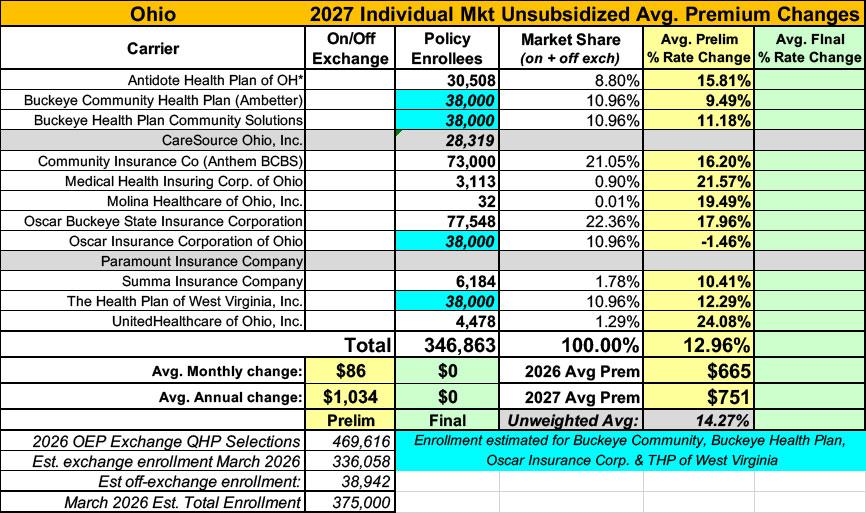
Unfortunately, I was only able to track down the effectuated enrollment for 8 of the 13 insurance carriers participating in Ohio's individual market this year. For the remaining four (one of which is leaving the Ohio market), I'm estimating ~38,000 apiece for the time being based on an assumed total market of roughly 375,000 (which includes the confirmed 336,000 as of spring 2026 plus perhaps another ~39,000 off-exchange enrollees). Obviously it's unlikely that all five have ~38,000 enrollees, but it's the best I can do for now.
Assuming these are reasonably close (or that they at least roughly cancel each other out), that puts Ohio's quasi-weighted average 2027 rate increase at around 13.0%.
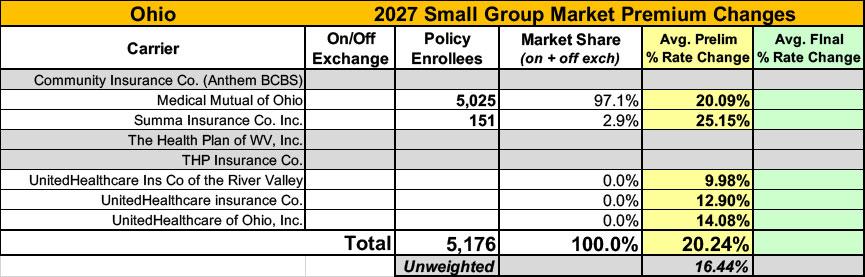
I don't have effectuated enrollment for most of Ohio's small group market carriers (and three of them appear to be pulling out of the state entirely), but the unweighted premium hike being requested averages 16.4%.
Advertisement


